Jakarta‘s coastal ports and the islands’ inter-island shipping routes mean your pipe will live in a highly corrosive chloride environment from the moment it lands. Standard FBE (fusion-bonded epoxy) can perform well in marine environments when correctly applied and protected. However, the transshipment and handling risks in Indonesian ports make an additional mechanical protection layer advisable.
What to change:
Upgrade to 3LPE (three-layer polyethylene), or consider a dual-system: FBE plus an outer polypropylene layer for mechanical protection during the brutal transshipment process.
Pay attention to cutback areas. In Indonesia, field joints are often done under unpredictable weather. Specify a high-solids, moisture-tolerant epoxy, and enforce the 3°C dew-point margin during field application—no coating will adhere properly if the substrate temperature is not at least 3°C above the dew point.
If the pipe is for buried service near coastal groundwater, add cathodic protection (CP) design considerations early. Don‘t assume the local contractor will know how to bond test stations—provide explicit termination lugs and test wire access.
Indonesia has two seasons: wet and wetter. A DN3900 pipe stored in an open yard in Surabaya will accumulate internal condensation that promotes internal corrosion, especially if the pipe has been hydrotested before shipping.
Adaptation strategy:
Ship with desiccant bags—not just a few, but a calculated quantity based on cargo volume and temperature deltas. Calculate desiccant quantity per unit internal volume (typically 1–2 units per cubic meter of pipe void), accounting for the temperature differential between loading port and destination. We document our internal humidity control plan in the shipping manifest.
Seal the ends with a vapor-proof cap that has a built-in pressure equalization valve. A rigid steel cap will sweat; a breather cap will breathe moisture in. Use threaded plastic or composite caps with a PTFE membrane.
When the pipe sits on site for more than 30 days before installation, require a weekly visual inspection of internal dew formation. It sounds basic, but it saves more pipes than any super-alloy.
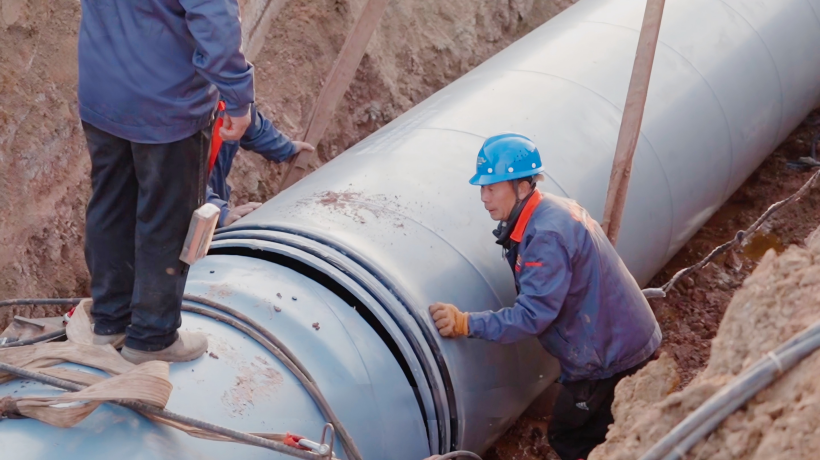
Indonesian ports—Tanjung Priok, Tanjung Perak, and smaller regional docks—share a reputation for rough handling. A DN3900 with a 50 mm wall thickness is heavy, but the lift points and sling mechanisms are where failure happens. Spiral-welded pipe distributes its seam helically, which helps distribute stresses—but any pipe of this diameter and weight demands careful handling regardless of seam type.
Our handling rulebook:
Mandate spreader beams with 120-degree contact saddles. Never use single-point wire rope slings.
Provide site-specific lifting lugs welded to a sacrificial section that is removed after placement, not welded to the main body.
If you can‘t control the crane operator, control the damage: apply a 15 mm thick rubber or composite padding at all contact points—cheap insurance against localized dents that can lead to buckling under internal pressure.
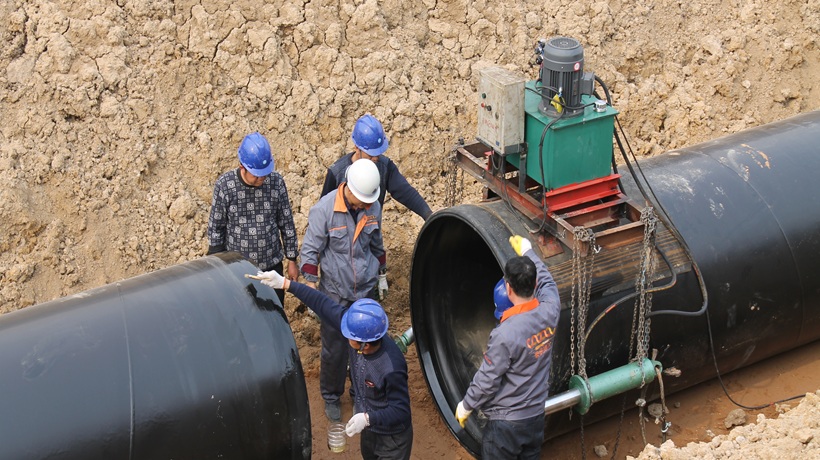
The spiral seam is a critical feature of the pipe. During field welding in Indonesia’s heat and humidity, the risk of hydrogen-induced cracking (HIC) spikes. Local welders often use E7018 rods that are excellent, but in humid air, they pick up moisture unless kept in portable ovens.
Field-fit changes:
Specify low-hydrogen electrodes with mandatory oven storage on site (140°F–150°F / 60°C–66°C at all times).
Preheat before any tack weld or root pass—even on annealed pipes. Preheat requirements must be matched to the carbon equivalent (CE) of the specific steel grade. For typical pipeline grades with CE ≤ 0.40, a minimum of 100°C is a reasonable baseline; higher-CE grades may require higher preheat. Verify against the mill certificate before mobilizing.
For the final closure weld, require post-weld heat treatment (PWHT) where specified by the applicable welding procedure—typically for thick-wall sections (e.g., >25 mm) or high-CE steels. Many pipeline grades do not require PWHT at standard thicknesses. Confirm the requirement against the governing standard (e.g., ASME B31.4/B31.8) before insisting on it. Many local contractors will argue it‘s unnecessary. Test a coupon first; the hardness numbers will settle the argument.
The internal diameter of DN3900 (about 3.77 m) is large enough for workers to climb inside—which they will, for inspection or repair. That’s fine. But stacking these pipes in a yard without proper cribbing is how you flatten a pipe‘s ends.
Localized best practice:
Determine stacking height based on wall thickness, support saddle spacing, and allowable ovality. For large-diameter thin-wall pipe, two tiers with full-width saddles is a safe default; verify by calculation for the specific wall thickness. The bottom pipe must be on concrete saddles with a full-width base plate to prevent sinking into the soft tropical soil (even if it looks dry on top).
Prohibit walking on the pipe’s top surface—the spiral seam can deform under concentrated foot traffic. Provide catwalks or require workers to use tack-welded brackets.
At the site, if the pipe is to be stored underwater (which Indonesian projects sometimes do for temporary holding), require flanged blind covers instead of welded caps. Yes, it‘s more money. But a welded cap that rusts through is worse.
The most overlooked adaptation isn’t material—it‘s literacy. Indonesian inspectors, port authorities, and site engineers often follow JIS (Japanese Industrial Standards) or DNV guidance, but not your original Chinese mill certificate.
What I insist on:
Provide bilingual technical data sheets (English/Bahasa Indonesia) for every heat number, including Charpy impact values at the weld centerline and HAZ at -20°C, even if the spec says -10°C. Local mud engineers will ask.
Include a simple diagram showing spiral seam orientation (left-hand/right-hand) and which end is the “field-weld end” for storage. In my experience, this one drawing prevents more field arguments than any QC report.
Carry a material traceability file in waterproof binders (not thumb drives—no one has power on a remote island).
We end every DN3900 export with a virtual site drill: a 30-minute tabletop where we simulate a monsoon hitting an unsecured valve, a crane failure at a tight bend, or a welder running out of dry rods. This isn‘t theory—it forces the field team to look at the pipe as a living system that reacts to its environment.
Indonesia doesn’t need a stronger steel; it needs a smarter steel strategy. The spiral pipe that thrives there is the one that was designed for dew point, rough hands, and forgotten wrenches.
Your pipe may be built to AWWA C200 or a specified wall thickness, but it‘s the environment that grades your job.
Haodeboer — Linking the World Through Pipes. From DN3900 to every export project, we build for the toughest environments.
No.1 Haodeboer Road, Qingdao, Shandong, China
Please fill in your information and let us get in touch with you.


 English
 Русский
 简体中文
简体中文
 Français
 Español
 عربي
عربي
 Prancis
